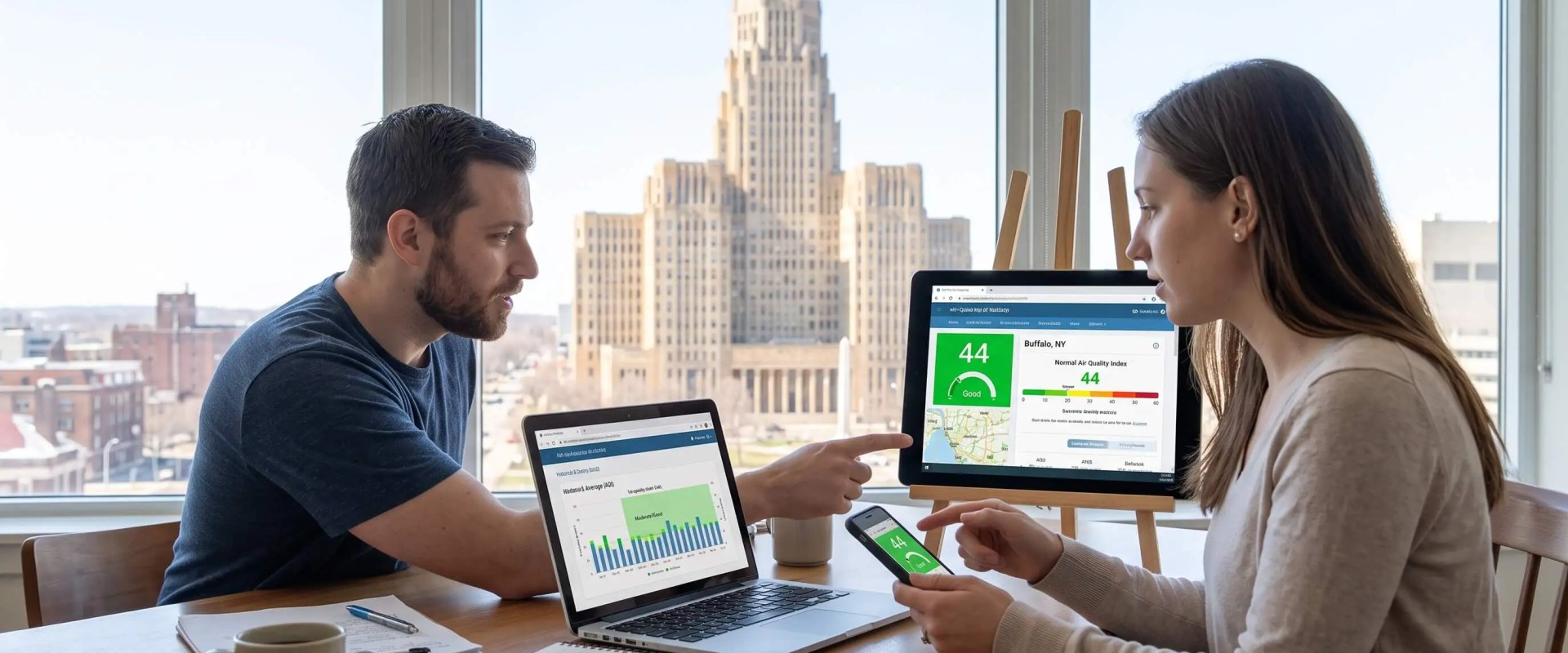
On June 7, 2023, AirNow rated the air over greater Buffalo Very Unhealthy, and the Erie County Department of Health asked families to postpone kids' games and adult leagues until it cleared. That day sat far outside normal for this city.
A normal air quality index for Buffalo, NY runs from 0 to 100, the EPA's Good and Moderate range, and that's where air quality in Buffalo, NY lands on most days. Readings above 100 usually trace back to summer ozone or to smoke blowing in from Canadian wildfires.
Most of what the AQI tracks is invisible. Fine particles measure a small fraction of the width of a hair, and ozone has no color at all, so a clear sky can still carry a reading worth checking. Don't take your air for granted, even on days it looks fine.
TL;DR Quick Answers
air quality Buffalo NY
Air quality in Buffalo, NY usually sits in the EPA’s Good (0 to 50) or Moderate (51 to 100) range. Readings above 100 aren’t normal and mostly come from summer ozone or Canadian wildfire smoke. Because the official number can trail fast-moving smoke by hours, check the live map rather than the sky.
Normal range: 0 to 100, Good or Moderate.
Action line: Above 100, sensitive groups should shorten their time outdoors.
Main drivers: PM2.5 from wildfire smoke and ground-level ozone on hot afternoons.
Peak season: Late May through August.
Indoor defense: A MERV 8 filter with the thermostat fan set to On.
Where to check: The live Buffalo AQI map and NYSDEC’s daily forecast for Western New York.
Top Takeaways
Buffalo's normal AQI runs from 0 to 100, covering the EPA's Good and Moderate categories.
Sensitive groups start to feel effects once readings pass 100.
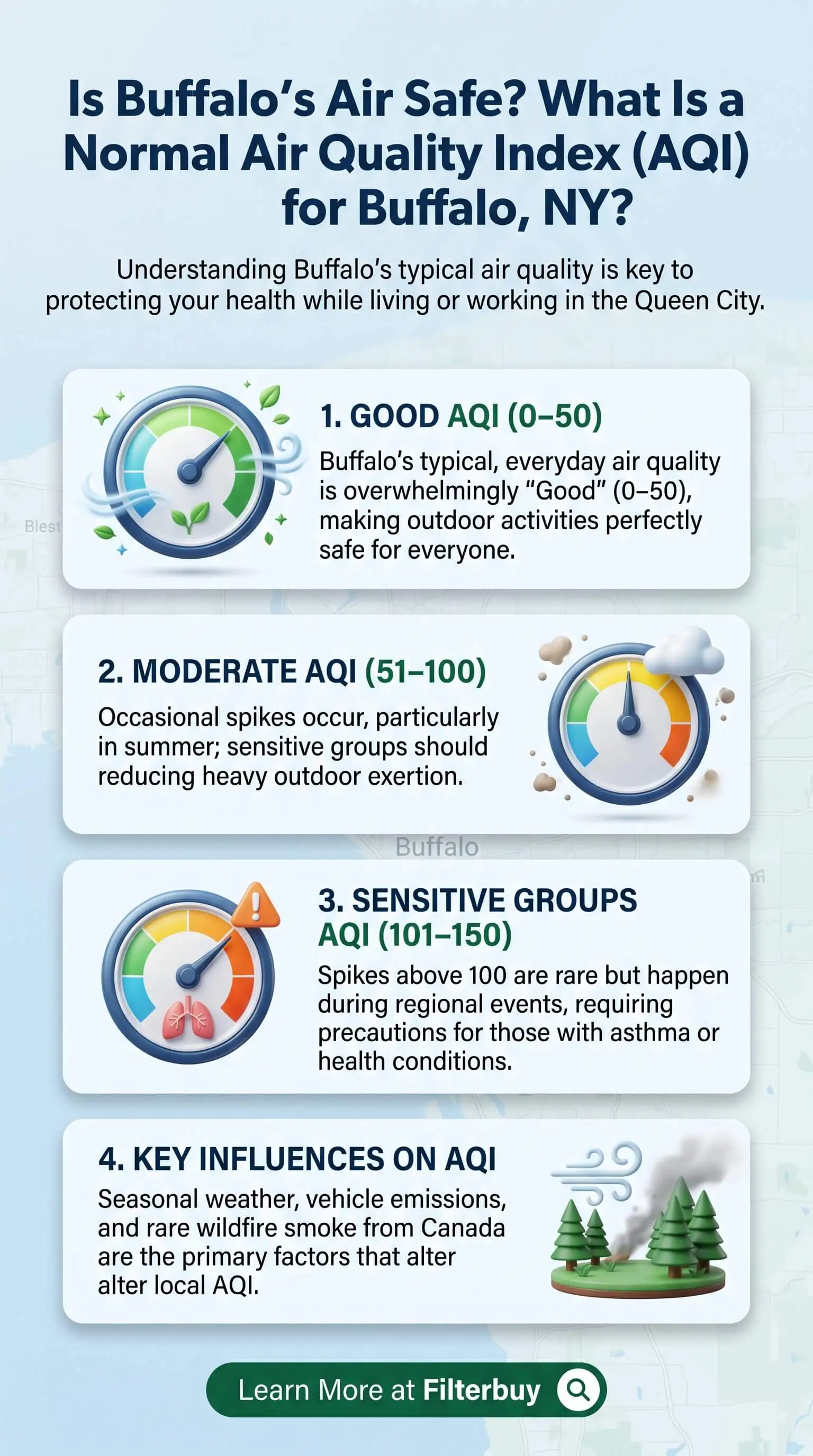
Summer ozone and Canadian wildfire smoke drive most of Buffalo's out-of-range days.
The live number can trail visible smoke, so trust the map over the sky.
Indoors, a MERV 13 filter, the fan set to On and a correctly sized air cleaner carry most of the load.
What Counts as a Normal AQI in Buffalo?
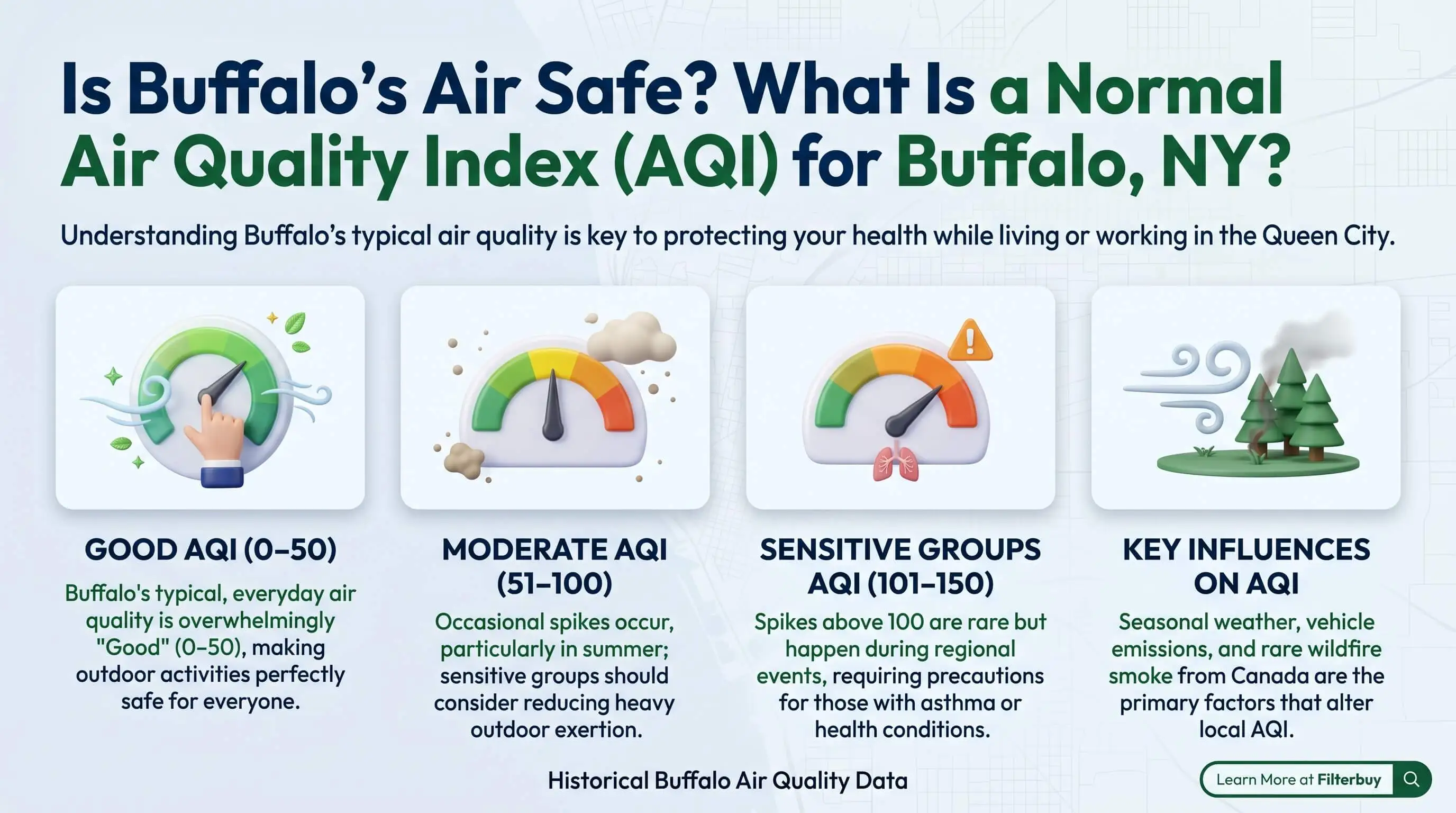
The EPA's air quality index runs from 0 to 500 and splits into six color-coded categories:
Good, 0 to 50, green: little or no risk.
Moderate, 51 to 100, yellow: fine for most people, though unusually sensitive people may notice symptoms.
Unhealthy for Sensitive Groups, 101 to 150, orange: children, older adults and people with heart or lung conditions may feel it.
Unhealthy, 151 to 200, red: some healthy adults start to feel it too.
Very Unhealthy, 201 to 300, purple: a health alert for everyone.
Hazardous, 301 and up, maroon: emergency conditions.
The line at 100 matters most. EPA AirNow ties an AQI of 100 to the short-term national health standard for each pollutant, so anything at or below it counts as satisfactory. Past 100, sensitive groups feel the effects first, and everyone else follows as the number climbs. Indoor air quality testing helps identify pollutants inside the home that outdoor AQI readings don't measure.
Why the Buffalo AQI Can Lag What You See
Buffalo's AQI almost always reflects PM2.5 or ground-level ozone, whichever scores higher that hour. NYSDEC averages ozone over 8 hours and particles over 24, and EPA estimates the current hour with a weighted method it calls NowCast. That math explains why a smoke plume rolling in over Lake Erie can look worse than the number for a few hours. DEC adds one more caution. The sensor readings in weather apps don't line up directly with the official AQI.
What Pushes Air Quality in Buffalo, NY Above Normal?
Hot, Sunny Ozone Afternoons
Heat and sunlight turn vehicle and industrial exhaust into ground-level ozone. Breezes off Lake Erie can then pin that ozone close to the ground over inland neighborhoods, which is why Buffalo's highest ozone readings tend to arrive on still summer afternoons instead of first thing in the morning.
Canadian Wildfire Smoke
Smoke knocks Buffalo out of its normal range more than anything else. After the June 2023 episode, smoke drifted back in August 2025. Then on July 15, 2026, New York issued a statewide Air Quality Health Advisory for fine particles.
Traffic and Border Corridors
Rush hour can push readings near the Peace Bridge, the I-190 and the Kensington Expressway above what suburban monitors show. A citywide figure averages all of that out, while a neighborhood-level map shows you the difference.
What Normal Looks Like in Buffalo by Season
Spring: mostly Good, with the first ozone days showing up in late May.
Summer: Moderate afternoons are routine, and smoke accounts for most of the year's out-of-range days.
Fall: usually the cleanest stretch on the calendar.
Winter: fine particles can build on cold, still days while furnaces and wood stoves run.
Is Buffalo's Air Safe for Sensitive Groups?
NYSDEC counts these groups as sensitive:
children and teens
older adults
pregnant people
anyone with asthma or a heart or lung condition
people who work or exercise outdoors
Buffalo has more at stake than most places. When the NYS Department of Health mapped asthma emergency visits, Buffalo ZIP codes showed more hot spots than any other upstate city in the analysis. Proper attic insulation, combined with air sealing, helps limit outdoor pollutants entering through gaps around the attic. If anyone in your home fits one of these groups, treat a reading above 100 as the moment to cut outdoor time short and follow the action plan from their health care provider.
How to Check Air Quality in Buffalo, NY Today
Start with this live air quality index map for Buffalo NY. It shows the current number, the category and the pollutant behind it. For tomorrow's outlook, NYSDEC forecasts air quality for its Western New York region, which covers Cattaraugus, Chautauqua, Erie, Genesee, Niagara, Orleans and Wyoming counties. DEC issues an Air Quality Health Advisory whenever it expects ozone or PM2.5 to top 100, and you can get those advisories by email through DEC Delivers.
What to Do Indoors When the AQI Climbs Past 100
Your home is your shelter on a bad air day, and your HVAC system does more of the protecting than most people realize. The EPA recommends these steps:
Put in a MERV 13 or higher filter if your system can handle one, and check that it sits snug in the slot.
Flip the thermostat fan from Auto to On so the system filters around the clock.
Run a portable air cleaner in the room you use most. Pick one with a smoke CADR of at least two-thirds of that room's square footage.
Skip ionizers and other electronic air cleaners, since some of them give off ozone.
Check the filter often during smoke and swap it out once it looks dirty.
A clogged filter holds back both airflow and cleaning power, so it pays to know the warning signs. This site's guide to filter replacement health benefits lays them out.
"In my years servicing HVAC systems, I've pulled filters after one heavy smoke week that looked months old, because fine smoke particles load a MERV 13 filter far faster than household dust. During smoke events, check yours every few days and replace it once it turns gray, before restricted airflow starts straining the blower."
7 Essential Resources
EPA AirNow: AQI Basics: what each of the six categories means for your health.
NYSDEC: AQI Forecast and Current Observations: tomorrow's forecast for Erie County and the rest of Western New York.
Erie County Department of Health: Hazardous Air Quality Guidance: the local guidance families received during the June 2023 smoke.
EPA: Indoor Air Filtration: how HVAC filters and portable cleaners cut smoke indoors.
NYS Department of Health: Exposure to Smoke from Fires: symptoms to watch for and when to call your doctor.
NY Governor's Office: July 2026 Statewide Air Quality Update: what the July 15, 2026 fine particle advisory covered.
Asthma and Allergy Foundation of America: Air Pollution and Asthma: how ozone and particles affect people living with asthma.
3 Supporting Statistics
Buffalo leads upstate asthma hot spots. A NYS Department of Health analysis flagged 19 Buffalo ZIP codes as asthma emergency visit hot spots from 2016 to 2019. Rochester had 12 and Syracuse had 11. Source: CDC, Preventing Chronic Disease (2024)
Smoke particles hit harder. Every 10 µg/m³ rise in wildfire PM2.5 lifted respiratory hospital admissions by 1.3% to 10%, while the same rise in PM2.5 from other sources lifted them 0.67% to 1.3%. Source: Nature Communications (2021), via National Library of Medicine
Buffalo's ozone ranking. Based on 2022 to 2024 data, the Buffalo-Cheektowaga-Olean metro ranked 143rd worst in the nation for ozone pollution. Source: American Lung Association, State of the Air 2026
Final Thoughts and Opinion
Here's my view. Buffalo's air stays in good shape most of the time, and that's exactly what makes the bad days so easy to miss. Smoke moves fast. The official number can trail it by hours, and the haze over the lake won't tell you much on its own.
I'd treat 100 as a personal action line rather than a reason to panic. Check the forecast on summer mornings, keep a spare high-efficiency filter on the shelf before smoke season starts, and let the live reading decide when you head inside. It takes little effort for a big payoff, and it keeps you in charge of the air your family breathes.
Frequently Asked Questions
What Is a Good AQI Level in Buffalo, NY?
Anything from 0 to 50 is Good, which means little or no risk. Moderate readings from 51 to 100 are still fine for most people. Both ranges count as normal for Buffalo, and only people who are unusually sensitive to air pollution need to adjust their plans when the number sits in the Moderate band.
Is an AQI of 100 Safe to Be Outside?
For most people, yes. A reading of 100 sits at the top of the Moderate range and generally matches the national short-term health standard. Kids, older adults and anyone with asthma or a heart or lung condition may want to ease off hard outdoor activity as the number nears or passes 100.
Why Is Buffalo's Air Quality Bad Today?
A Buffalo reading above 100 usually comes from ground-level ozone on a hot, sunny afternoon or from wildfire smoke drifting down from Canada. The live map names the pollutant behind the number. PM2.5 suggests smoke or other fine particles, and ozone points to heat, sunlight and traffic exhaust.
When Is Air Quality Worst in Buffalo?
Summer brings most of Buffalo's unhealthy air days. Ozone peaks on hot, still afternoons from late May through August, and Canadian wildfire smoke triggered advisories in June 2023, August 2025 and July 2026. Winter can add smaller particle buildups on cold, calm days while heating systems work hard.
Does Canadian Wildfire Smoke Reach Buffalo?
Yes. Smoke from fires in Quebec, Ontario and Manitoba has reached Western New York in several recent summers. AirNow rated the Buffalo area Very Unhealthy in June 2023, and New York issued a statewide fine particle advisory on July 15, 2026, when smoke returned.
How Do I Get Air Quality Alerts for Western New York?
Sign up for NYSDEC's DEC Delivers emails to receive Air Quality Health Advisories, and use EPA's AirNow app for current readings and forecasts by ZIP code. DEC sends an advisory for its Western New York region whenever it expects ozone or PM2.5 to pass an AQI of 100.
Know Your Normal Before the Next Smoke Day
A normal air quality index for Buffalo, NY stays at 100 or below, and anything higher is your cue to rethink the day. Check the reading on summer mornings and keep a fresh high-efficiency filter in your HVAC system to help the air inside your home stay cleaner than the air outside on smoke days.