TL;DR Quick Answers
top HVAC system replacement near Clermont FL
A top HVAC system replacement near Clermont FL means a contractor who delivers all four:
Verified Florida CAC license (check MyFloridaLicense.com)
A real Manual J load calculation before any pricing conversation
AHRI matched-system certificate on the equipment
Lake County permit history you can look up online
Skip any bid missing one.
Top Takeaways
Verify the license at MyFloridaLicense.com first. Florida-certified HVAC contractors hold a CAC license; the verification takes two minutes and costs nothing.
A real Manual J load calculation beats square-foot rules every time. Oversized systems short-cycle and lose humidity control in our climate.
SEER2 ratings only count when the indoor and outdoor units are an AHRI-matched pair. Always ask for the certificate number on the quote.
Cheap quotes skip the line items that matter. Ductwork remediation, the permit, post-install commissioning, and a workmanship warranty all belong on the page.
Lake County permit history is public information. A contractor with no Lake County permits on file isn’t local enough to handle your install.
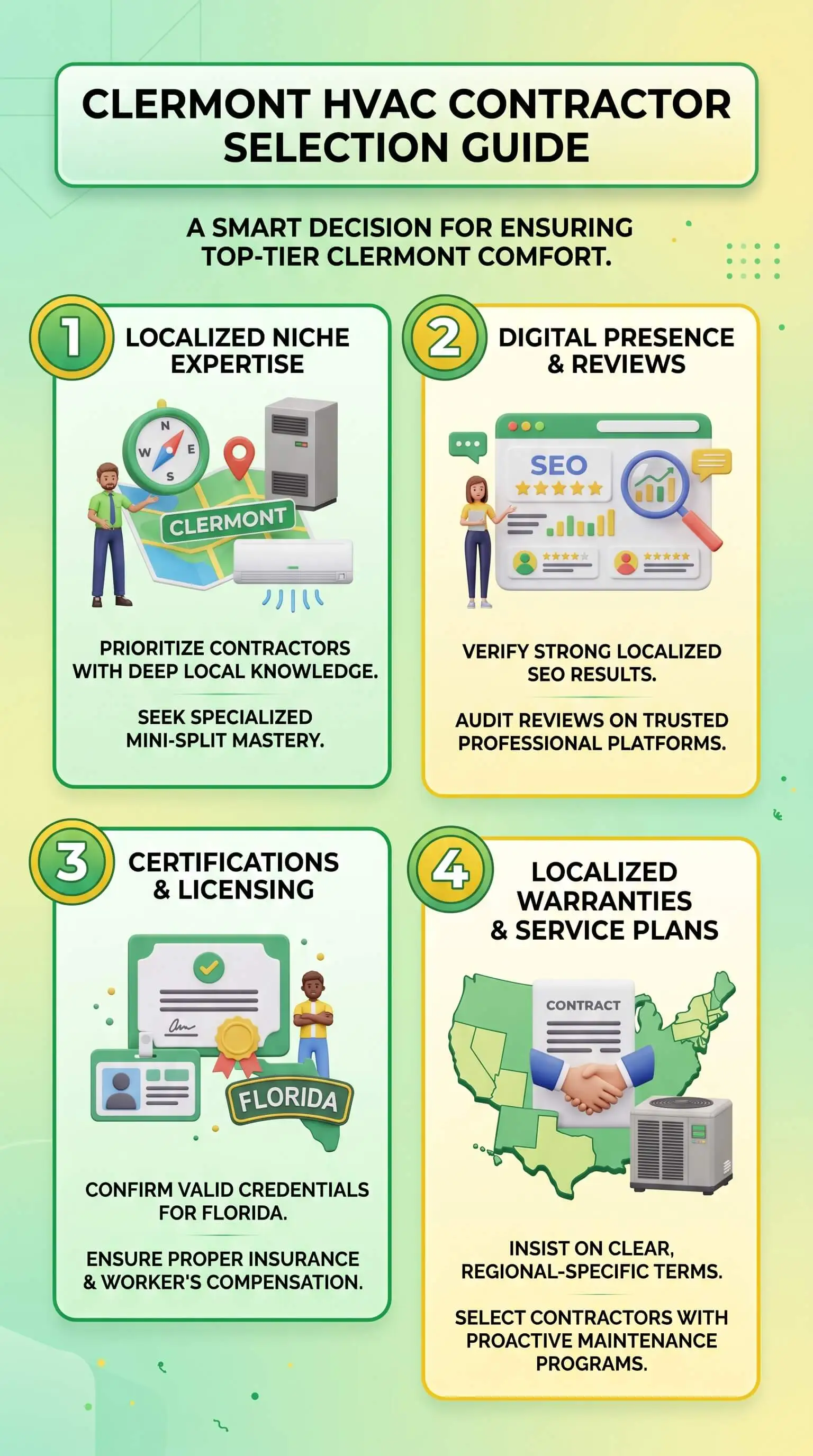
Verify the License, Insurance, and Local Track Record First
Anyone who is replacing or installing a residential AC system in Florida has to hold a state license through DBPR. The two flavors that matter for residential work are Class A (the unlimited scope license) and Class B (which covers systems up to 25 tons of cooling and 500,000 BTU of heating). That matters even more when homeowners are comparing companies for HVAC replacement Clermont services and trying to avoid uninsured or unqualified contractors. State-certified license numbers all start with the letters CAC, and the verification at MyFloridaLicense.com takes about two minutes. Current status, qualifying agent’s name, issue and expiration dates, and any disciplinary actions on file all show up on a single screen. If a contractor stalls when you ask for their license number, that’s the only data point you really need.
Insurance comes next. General liability is what protects the home itself if something goes sideways during the install. Workers’ comp is what protects you if a tech goes off the ladder in your attic and decides to sue. You want both on the certificate of insurance, and you want the certificate to name you as a third party. Either one missing is reason enough to walk.
Local track record is the third thing we look at, and it’s easier to verify than most people realize. The Lake County Office of Building Services keeps a public permit search; you type the contractor’s name in and you can see how many residential AC change-outs they’ve actually pulled in the last few years, where those installs were, and whether the inspections passed. A company with a slick website and zero permits on file in Lake County is selling you something, and it isn’t local experience. We also pay attention to whether their Google Business Profile reviews are tied to real addresses inside our service area, since out-of-county review farms are a common dressing-up tactic. Once the licensing and the permit history check out, NADCA membership and NATE-certified installers are real quality signals worth weighing.
Insist on a Manual J Load Calculation, Not a Rule-of-Thumb Sizing
Ask any contractor on your shortlist one question: how are you going to size the system? If the answer involves a number of square feet per ton, you already have your answer about the rest of their work too. The same attention to detail that separates quality installation work from rushed jobs also matters in long-term HVAC repair performance and system reliability. The contractor you actually want will say “we’ll run a Manual J.” A Manual J is the load calculation that ACCA publishes, and it’s the only sizing method Florida’s energy code actually recognizes for residential design. It pulls in insulation values, window orientation, infiltration, where the ducts live, and the design temperatures specific to your ZIP code, then produces a room-by-room load sheet rather than a one-line tonnage estimate.
Here’s why this matters more in Clermont than in, say, a place like Phoenix. Oversized systems short-cycle: they cool the air down to the thermostat setpoint fast and then shut off before they’ve pulled enough moisture out of the house. Our dewpoints sit in the low to mid 70s for months at a stretch, so a system running short cycles in those conditions leaves a house feeling clammy at 75 degrees on the thermostat. The Department of Energy makes the same point in its hot-humid-climate guidance: oversized air conditioners are one of the most common reasons homes feel damp even when the thermostat reads cool.
The other reason square-foot rules fail in Clermont is the spread in our housing stock. A 1980s ranch in Old Clermont running on undersized return ducts has a load profile that looks nothing like a 2018 build over in Sanctuary Ridge or Johns Lake Landing with foam insulation and low-e windows. The square footage on the property card might be identical, but the actual ton requirement won’t be. Anyone telling you the two homes need the same equipment isn’t doing the math.
Compare Equipment on SEER2, Matched Systems, and the Refrigerant Roadmap
The efficiency rating game changed in January 2023. The federal standard moved from SEER to SEER2, which is the same idea measured under tougher conditions; a number on the new test reflects what the system actually does once it’s connected to a real home’s ductwork. The minimum we have to meet down here in the southeast is 15.0 SEER2 for split-system air conditioners. ENERGY STAR certified equipment runs above that floor, starting at 16.0 SEER2 for central AC and 16.7 SEER2 / 8.5 HSPF2 for heat pumps.
On the quote itself, the two things we’d zero in on are the AHRI matched-system certificate and the refrigerant. SEER2 ratings only apply to an indoor coil and an outdoor condenser that were actually tested together as a pair. If the quote in front of you pairs an outdoor unit from one model line with an air handler from a different one, ask for the AHRI certificate number before you sign anything. No certificate, no rating. The system will run, sure, but it’ll run at whatever efficiency the mismatch produces, which is almost always well below the number printed on the spec sheet.
Refrigerant is the other line item to read carefully. The industry has been moving away from R-410A and toward lower-global-warming-potential refrigerants like R-454B for the last couple of years. Both work fine. What’s changing is the parts and service ecosystem, which is steadily shifting toward R-454B. So if a contractor is quoting you a brand-new install in 2026, we’d ask them to walk you through which refrigerant is going in, why they picked it, and what that means for repair availability ten years out. A blank stare on that question tells you something.
Read the Quote Like a Contract: What Belongs and What Doesn’t
A real change-out quote reads like a parts list, not a lump sum. The condenser, air handler, and coil need to be there by make and model. The refrigerant type, the tonnage, and the SEER2 rating with the AHRI certificate number all need to be there too. The permit fee should be a separate line item, whether it’s pulled with Lake County or with the City of Clermont depending on which side of the city limit your address sits on. Same for any new electrical disconnect or whip required by code, a new pad, new condensate piping with a float switch, and either a new thermostat or written confirmation that the existing one will work with the new equipment.
The line items that get left off cheap quotes are the ones that hurt later. Ductwork is the biggest of them. Putting a brand-new 16 SEER2 system onto a collapsed flex duct from a 1992 install is like putting new tires on a car with a bent frame; the equipment will run, but it will never deliver the rated performance the sticker promised. The honest contractors look at the ductwork before they price the equipment, and they tell you straight whether yours can stay or whether it needs work. The second item that tends to vanish from cheap quotes is post-install commissioning. Refrigerant charge, static pressure, and superheat or subcooling readings all need to be recorded after the install is done. If those numbers aren’t on paper, no one can tell you whether the system is actually running on spec.
The last thing we look at on a quote is the workmanship warranty. The manufacturer warranty covers the compressor and parts if the equipment itself fails. The workmanship warranty is the contractor’s own promise to come back and fix things if the install was the reason something went wrong. That’s one of the biggest differences between an average install and a top HVAC replacement company that truly stands behind its work. A one-year workmanship warranty is the absolute floor; two to ten years is what we’d want to see from a contractor with real confidence in their crews.

“In our service area, the systems we’ve replaced earliest are almost always the ones that were oversized at install. We pulled a 4-ton condenser out of a 1,950-square-foot home in 34711 last summer where the original install paperwork showed no Manual J was ever run. The compressor died at year nine because it had been short-cycling its whole life. The right size system in that house was 2.5 tons.”
7 Essential Resources
These are the seven sources we send Clermont neighbors to most often when they’re trying to make sense of a replacement decision on their own. All seven were live at the time of publication.
ENERGY STAR — Heat & Cool Efficiently: energystar.gov/saveathome/heating-cooling
U.S. Department of Energy — Heating and Cooling: energy.gov/energysaver/heating-and-cooling
U.S. DOE — Efficient Cooling for Hot, Humid Climates: energy.gov/energysaver/efficient-cooling-hot-humid-climates
U.S. EPA — Indoor Air Quality (IAQ): epa.gov/indoor-air-quality-iaq
Florida DBPR — License Verification: myfloridalicense.com
Lake County, FL — Office of Building Services: lakecountyfl.gov/building-services
Wikipedia — Heating, ventilation, and air conditioning: en.wikipedia.org/wiki/Heating,_ventilation,_and_air_conditioning
These seven trusted resources give Clermont homeowners the knowledge and confidence to choose a top HVAC system replacement by helping them compare energy-efficient systems, verify contractor licensing, understand Florida building requirements, and make informed decisions that lead to better comfort, cleaner air, and long-term system reliability.
3 Supporting Statistics
All three figures below are pulled from primary .gov sources and were live at the time of publication.
Nearly half of the energy used in a typical U.S. home goes to heating and cooling, which is why getting the replacement decision right has such a big impact on operating cost. Source: ENERGY STAR — Heat & Cool Efficiently.
Improper HVAC installation can reduce system efficiency by up to 30 percent, costing more on utility bills and possibly shortening equipment life. Source: ENERGY STAR — Heat & Cool Efficiently.
Americans on average spend approximately 90 percent of their time indoors, where concentrations of some pollutants run two to five times higher than typical outdoor concentrations — the case for getting your replacement system’s air handling and filtration right the first time. Source: U.S. EPA — Report on the Environment, Indoor Air Quality.
Final Thoughts and Opinion
Run any quote you’re holding through these four filters: license verification, real Manual J sizing, SEER2 with a matched-system certificate, and a line-itemed quote you can read like a contract. None of them are exotic, and that’s the point. All four take a contractor an extra hour or two to do properly, which is exactly the reason the cheap bids cut them.
If we were sitting at our own kitchen table tomorrow with three quotes for our own house, the first thing we’d do is run the license number through MyFloridaLicense.com before reading another word. After that, we’d ask for the Manual J before we asked for a price, ask for the AHRI certificate number once the price came back, and read every line item end to end before signing anything. Those are the same habits homeowners should expect from any company offering professional HVAC replacement services. The contractor who handles those four steps without flinching is almost always the same contractor whose system is still running clean ten summers later.
Frequently Asked Questions
1. How do I verify a Clermont HVAC contractor’s license?
Head to MyFloridaLicense.com and search either by name or by license number. State-certified air-conditioning contractors hold a license number starting with CAC. Pull it up and look for “Current, Active” status, the qualifying agent listed, the expiration date, and any disciplinary actions on file. The whole check takes about two minutes and costs nothing.
2. What’s a fair price range for HVAC replacement in Clermont, FL?
Honest answer: it depends on tonnage, SEER2 tier, ductwork condition, and whether you’re moving from a straight AC to a heat pump. The bigger point is that any quote without a Manual J load calculation behind it is a guess no matter how good the price looks. Three line-itemed quotes is the minimum we’d want before signing anything.
Specific price ranges require operations team confirmation before publication.
3. How long should a new HVAC system last in Central Florida?
A right-sized system that was installed cleanly should give you 12 to 15 years of service in Clermont, sometimes more with annual maintenance. The reason it’s not 20 like it might be in Ohio is that our equipment runs nearly year-round. Condensers down here take a lot more pollen and humidity exposure, and compressors log a lot more run-time hours than they would up north.
4. Do I need a permit to replace my HVAC system in Lake County?
Yes. AC change-outs in this area need a permit through the Lake County Office of Building Services if you’re at an unincorporated address, or through the City of Clermont’s building department if you’re inside city limits. The contractor pulls the permit, books the inspection, and the inspector signs off when the work meets code. Any contractor offering to skip the permit to shave a few dollars off the price is not a contractor you want anywhere near your equipment.
5. Should I repair or replace a 12-year-old AC unit?
Our usual rule of thumb is the half-and-ten rule. If the repair quote is more than half the cost of a new system and the unit is over 10 years old, replacement usually wins on total lifecycle cost. Add in R-410A refrigerant getting more expensive as it phases out, plus the efficiency drag of an aging compressor, and the math tips a little further toward replacement every year.
6. What SEER2 rating should I choose for a Clermont home?
The federal minimum down here in the southeast is 15.0 SEER2 for split-system air conditioners. ENERGY STAR certified equipment starts at 16.0 SEER2 for central AC and 16.7 SEER2 / 8.5 HSPF2 for heat pumps. In our experience, the sweet spot for most Clermont homes lands in the 16 to 18 SEER2 range. The jump to 20+ rarely pays back over the equipment’s life unless the home runs heavy cooling loads, like a glass-heavy great room facing west or a lakefront elevation that bakes all afternoon.
7. How long does an HVAC replacement install take?
For a clean change-out with no ductwork surprises, plan on one full day on site, usually 6 to 8 hours from disconnect to commissioning. Add half a day or so if the ducts need repair, the return air needs resizing, or the attic platform needs rework. We always recommend a morning start when the calendar allows it, since you want the commissioning step to wrap before the attic hits its 130-plus afternoon peak.
Ready to Compare a Real Quote Against the One You Have?
Set up a no-pressure replacement consultation with one of our Clermont-area technicians. We’ll walk the system with you, run the Manual J ourselves, and hand you a line-itemed quote you can put side-by-side with any other bid in town.
Choosing the right contractor for a full HVAC installation involves more than just comparing prices. In How to Choose the Best HVAC Contractor in Clermont for a System Replacement, we explain why long-term system performance often comes down to installation quality, airflow planning, and ongoing maintenance recommendations. One detail experienced contractors never overlook is proper air filtration, since dirty or restrictive filters can reduce efficiency and shorten system lifespan. Homeowners can help protect their investment with products like 12x18x1 pleated furnace filters, 16x25x1 MERV 8 HVAC air filters, or pleated AC furnace replacement filters, all of which support cleaner airflow and more reliable HVAC performance throughout Florida’s demanding cooling season.