Those questions are normal. They’re also answerable. Winter Park, Florida is a community with a specific set of HVAC demands that most national resources don’t address directly. The proximity to the Chain of Lakes adds real humidity load to homes throughout the area. Many properties, particularly in the College Quarter, Virginia Heights, and along Lakemont Avenue, were built between the 1940s and 1980s, with ductwork designed for older, less efficient equipment. Central Florida’s near-year-round cooling season means your system runs roughly eight to nine months annually, which puts it on an accelerated aging schedule compared to most of the country.
Serving homeowners across Winter Park, Florida and the wider Orange County area, we’ve guided first-time buyers through this process more times than we can count. The questions are almost always the same. This page answers all of them.
TL;DR Quick Answers
Top HVAC System Replacement Near Winter Park FL
From what we've seen working in homes across Winter Park, the top-rated HVAC replacement companies in this market share a few qualities that go well beyond the lowest quote: they're licensed by the Florida DBPR, they pull permits on every job, and they size every system using a Manual J load calculation before recommending any equipment.
What sets the best apart in this market:
Florida DBPR license, verified. State law requires it. Any contractor who can't produce one shouldn't be in your home.
Manual J load calculation performed before equipment is selected. Winter Park homes, especially those near the Chain of Lakes, carry higher humidity loads than contractors from outside the area often account for. An oversized system short-cycles and leaves the house feeling muggy regardless of what the thermostat reads.
Permit pulled on every job. No exceptions. A permit triggers a county inspection that protects your home and its resale value.
Written, itemized estimate after an in-home visit. Top replacement companies don't quote over the phone. They see the home first.
Ductwork inspection included in scope. Older homes in neighborhoods like the College Quarter and Virginia Heights often have undersized or leaky ducts. New equipment connected to a compromised duct system underperforms from the first week.
Written warranty covering both parts and labor. Manufacturer coverage and contractor labor coverage are separate. The best contractors explain both before you sign.
In a climate where AC runs eight to nine months of the year, installation quality matters more than the brand name on the equipment. A properly sized, permitted, and inspected system from a licensed local contractor is what top HVAC system replacement near Winter Park FL looks like in practice.
Top Takeaways
Systems 10 to 15 years old in Florida’s climate are strong replacement candidates, even before they fail outright.
A Manual J load calculation is the foundation of every properly sized HVAC replacement. This step should never be skipped.
Florida law requires a licensed contractor to pull a permit for any HVAC system replacement. Walk away from any contractor who suggests otherwise.
Installed replacement costs in Winter Park FL typically range from $5,000 to $13,000+, depending on system type, efficiency tier, and ductwork condition.
Ductwork inspection belongs in every replacement project. New equipment connected to leaky ducts underperforms from day one.
Written, itemized estimates protect you. Verbal phone quotes do not.
Federal tax credits may apply to qualifying high-efficiency systems. Confirm eligibility with your contractor before selecting equipment.
Your First HVAC Replacement in 5 Steps
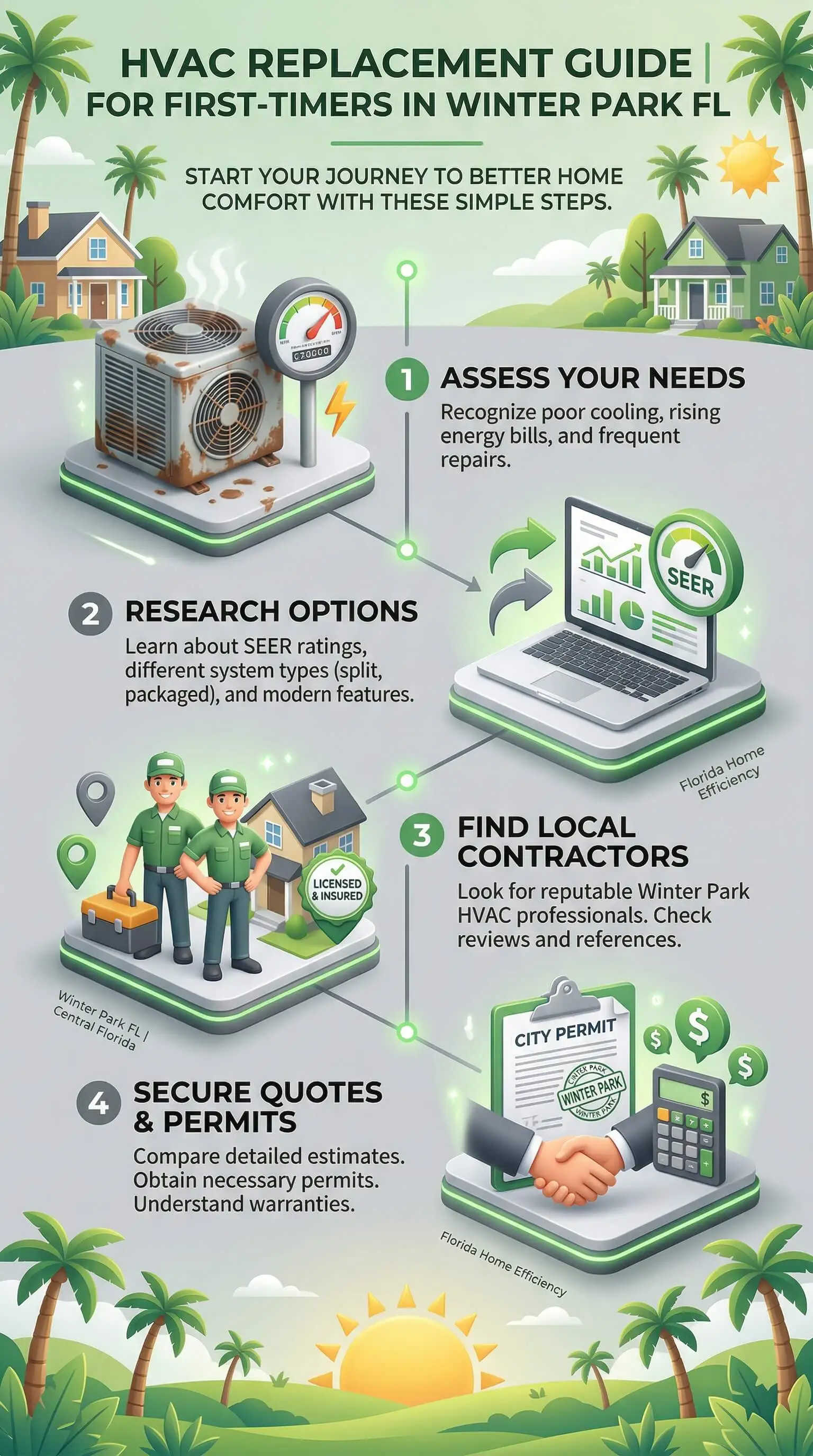
Step 1: Know the Signs That Replacement Is the Right Call
The first question to settle is whether you need a full replacement or whether a well-targeted repair will extend your system’s life by several useful years. A few indicators point strongly toward replacement:
Your system is 10 to 15 years old. In Florida’s climate, continuous operation pushes most central AC units toward the lower end of their expected lifespan.
Repair costs are stacking up. If a single repair estimate runs more than 50% of what a new system would cost to install, replacement is almost always the stronger financial decision.
Your home never quite reaches the set temperature. Short cycling and uneven cooling often indicate a system that’s failing, undersized, or was improperly installed from the start.
Energy bills have been climbing without a clear explanation. A system losing efficiency quietly raises your costs before it fails visibly.
Refrigerant leaks keep recurring. Systems still running R-22 refrigerant face increasing repair costs as that refrigerant has phased out of production.
Step 2: Understand What the Replacement Process Actually Looks Like
A first-time replacement feels far less overwhelming once you know what to expect from first call to final inspection. Here’s what a properly managed project looks like:
Free in-home evaluation and Manual J load calculation — the foundational step that determines the correct system size for your specific home.
Equipment selection and written estimate — your contractor presents options based on your home’s calculated requirements, not just what’s in stock.
Permit pulled by your licensed contractor — Florida law requires this for any HVAC replacement. This step protects you and your home’s resale value.
Installation day — old unit removed, new system installed, refrigerant charged, and airflow balanced. Most standard residential installations run 4 to 8 hours.
System test, thermostat calibration, and homeowner walkthrough — you should understand how your new system operates before the technician leaves.
County inspection — scheduled within days of installation to confirm the work meets Florida building code standards.
Step 3: Questions to Ask Before You Sign Anything
These are the questions worth asking before committing to any contractor. The right contractor will answer every one of them without hesitation:
Are you licensed and insured in the state of Florida? Required by law. Verify the license at the Florida DBPR before you agree to anything.
Will you perform a Manual J load calculation? If the answer is no, keep looking. An oversized system short-cycles, which creates humidity problems your family will feel every day.
What SEER2 rating do you recommend for my home? Florida’s long cooling season makes efficiency ratings a direct driver of your monthly utility bill.
Will you pull the permit? Any contractor who suggests skipping the permit is a red flag worth taking seriously.
What does the warranty cover, and who backs it? Manufacturer equipment warranties and contractor labor warranties are separate. Understand both before you sign.
Is ductwork inspection included? Leaky ducts can undermine a new system’s efficiency from the first week of operation.
Step 4: What Does HVAC Replacement Cost in Winter Park FL?
Installed HVAC replacement costs in Winter Park typically fall within these ranges:
Standard central AC system (2 to 3 ton): $5,000 to $9,000
High-efficiency system (SEER2 18+): $8,000 to $13,000
Full system replacement including air handler and ductwork repair: $10,000 to $18,000+
These figures reflect installed costs, not equipment-only pricing. What you’ll actually pay depends on your home’s square footage, existing ductwork condition, the efficiency tier you select, and current equipment pricing from your chosen contractor. Always request a written, itemized estimate rather than a verbal ballpark given over the phone.
Step 5: Choose the Right Contractor in Winter Park FL
The equipment choice matters less than most first-time buyers expect. Installation quality is the bigger variable. A high-efficiency unit installed carelessly will underperform a mid-tier unit installed correctly.
Look for contractors who are licensed by the Florida Department of Business and Professional Regulation, carry both liability insurance and workers’ compensation, pull permits on every job without exception, offer written warranties covering both parts and labor, and provide itemized written estimates based on an in-home site visit.
Red flags worth walking away from: any contractor who prices the job over the phone without seeing the home, anyone who suggests skipping or rushing the permit, and any contractor applying pressure to decide the same day.
“The homes we service in Winter Park, especially those in the older neighborhoods near the lakes, carry humidity loads that are easy to underestimate without a proper load calculation. In this climate, the system runs close to year-round, and oversizing is one of the most common installation mistakes we correct when homeowners call us after a frustrating experience with another contractor. Getting the sizing right from day one is what separates a system that performs well for 15 years from one that’s back in service calls by the second summer.”
Essential Resources
Know What Your New System’s Efficiency Ratings Mean Before You Buy
The U.S. Department of Energy’s central air conditioning guide explains cooling load calculations, SEER2 efficiency ratings, and how to evaluate whether a contractor is sizing your system correctly for your home.
Source: https://www.energy.gov/energysaver/central-air-conditioning
Find Out If Your Replacement Qualifies for a Federal Tax Credit
ENERGY STAR’s federal tax credit page lists qualifying high-efficiency central air conditioners and heat pumps, along with the credit amounts available for systems installed under the Inflation Reduction Act.
Source: https://www.energystar.gov/about/federal_tax_credits/central_air_conditioning
Verify Your Contractor’s Florida License Before You Hire Anyone
The Florida Department of Business and Professional Regulation’s online license lookup tool lets you confirm any HVAC contractor’s active license status in seconds, a step that protects you legally and financially before any work begins.
Source: https://www.myfloridalicense.com/wl11.asp
Understand What Ductwork Condition Does to Your Indoor Air Quality
The EPA’s indoor air quality resource center explains how leaky or poorly maintained ductwork affects both the air your family breathes and the efficiency of any HVAC system, new or old.
Source: https://www.epa.gov/indoor-air-quality-iaq
Compare Certified High-Efficiency Central AC Units Side by Side
ENERGY STAR’s certified product directory lets you search and compare central air conditioners by efficiency rating, capacity, and federal tax credit eligibility before sitting down with a contractor.
Source: https://www.energystar.gov/productfinder/product/certified-central-air-conditioners/details.html
Learn Whether a Heat Pump Makes More Sense for a Florida Home
The Department of Energy’s heat pump resource explains how modern heat pumps perform in warm climates, relevant for Winter Park homeowners deciding between a traditional split system and a heat pump replacement.
Source: https://www.energy.gov/energysaver/heat-pump-systems
Know What Proper HVAC Maintenance Looks Like After Installation
The Department of Energy’s air conditioner maintenance guide walks homeowners through the ongoing care that protects a new system’s efficiency and extends its lifespan, essential reading for first-time system owners.
Source: https://www.energy.gov/energysaver/air-conditioner-maintenance
Supporting Statistics
Heating and Cooling Account for More Than Half of Your Home’s Energy Use
Heating and cooling represent approximately 52% of a typical household’s total energy consumption, making the HVAC system the single largest driver of monthly utility costs. In Florida, where air conditioning runs nearly year-round, that share climbs well above the national average. A more efficient replacement system pays for part of itself through lower monthly bills.
Source: https://www.eia.gov/energyexplained/use-of-energy/homes.php
Leaky Ductwork Can Cost You Up to 30% of Your New System’s Output
Up to 30% of the conditioned air in a typical home is lost through leaky or uninsulated ductwork before it reaches a living space. For homeowners investing in a new HVAC system in Winter Park, ductwork inspection is a critical part of the replacement project, not an optional add-on.
Source: https://www.energy.gov/energysaver/air-sealing-your-home
Upgrading to a High-Efficiency System Can Reduce Cooling Costs by Up to 40%
Replacing an older system running at SEER 10 or below with a high-efficiency model rated at SEER2 16 or higher can reduce cooling costs by 20 to 40%. In a climate where air conditioning runs most of the year, that savings compounds month after month.
Source: https://www.energystar.gov/products/air_source_heat_pumps
Final Thoughts
Replacing an HVAC system for the first time in Winter Park FL is a bigger decision than most homeowners expect, and a more manageable one than most homeowners fear. The process, the costs, and the contractor selection all come into focus quickly once you know what to look for and what questions to ask.
From years of serving homes in this community, the pattern we see consistently is this: homeowners who slow down before signing anything get better outcomes. They ask for the load calculation. They check the license. They read the warranty. They get at least two written estimates. That process takes a few extra days. The system they end up with lasts a decade or more and performs the way they expected when they paid for it.
For first-time replacement buyers in Winter Park, you hold more leverage than you realize. A reliable local contractor will welcome your questions, answer them clearly, and treat your home as the serious investment it is. That’s the standard you’re entitled to, and it’s the standard worth holding every contractor to before you commit.
Frequently Asked Questions
Q: How do I know if I need to repair or replace my HVAC system in Winter Park FL?
If your system is 10 to 15 years old and has required multiple repairs in recent years, replacement is likely the stronger long-term investment.
Use the 50% rule: if a single repair estimate exceeds 50% of the cost of a comparable new system installed, replace rather than repair.
In Central Florida’s climate, near-continuous operation accelerates wear, and most systems here reach the end of their practical lifespan closer to the 10- to 12-year mark.
Q: What is a Manual J load calculation and why does it matter for my replacement?
A Manual J is the industry-standard method for determining the correct HVAC system size for a specific home.
It accounts for square footage, ceiling height, insulation levels, window placement, and local climate data, all of which vary significantly across Winter Park’s older and newer housing stock.
Without it, a contractor is estimating. An oversized system short-cycles and creates humidity problems that are especially noticeable in homes near the Chain of Lakes.
Q: Do I need a permit for HVAC replacement in Winter Park FL?
Yes. Florida state law requires a licensed HVAC contractor to pull a permit for any residential HVAC replacement.
The permit triggers a county inspection that verifies the installation meets Florida building code standards.
Remove any contractor from consideration who suggests skipping the permit.
Q: How long does an HVAC replacement take in Winter Park FL?
A standard residential replacement typically runs 4 to 8 hours from start to finish.
Ductwork repairs or partial replacements will add time to the project. Confirm the full scope before installation day.
Your contractor should not leave until the system has been tested, the thermostat calibrated, and you’ve been walked through how everything operates.
Q: What SEER2 rating should I look for in Winter Park FL?
A minimum SEER2 rating of 15 is recommended for Central Florida homes.
Systems rated SEER2 18 or above offer the strongest long-term energy savings, though at a higher upfront investment.
A licensed technician can calculate the estimated payback period for a higher-efficiency upgrade based on your home’s size and typical usage patterns.
Q: How much does HVAC replacement cost in Winter Park FL?
Installed costs range from $5,000 to $9,000 for a standard system, $8,000 to $13,000 for a high-efficiency unit, and $10,000 to $18,000+ for a full replacement including air handler and ductwork work.
Actual pricing depends on home size, ductwork condition, selected equipment, and current pricing from your chosen contractor.
Request a written, itemized estimate from each contractor after an in-home visit. Phone quotes are not a reliable basis for comparison.
Quick Answers
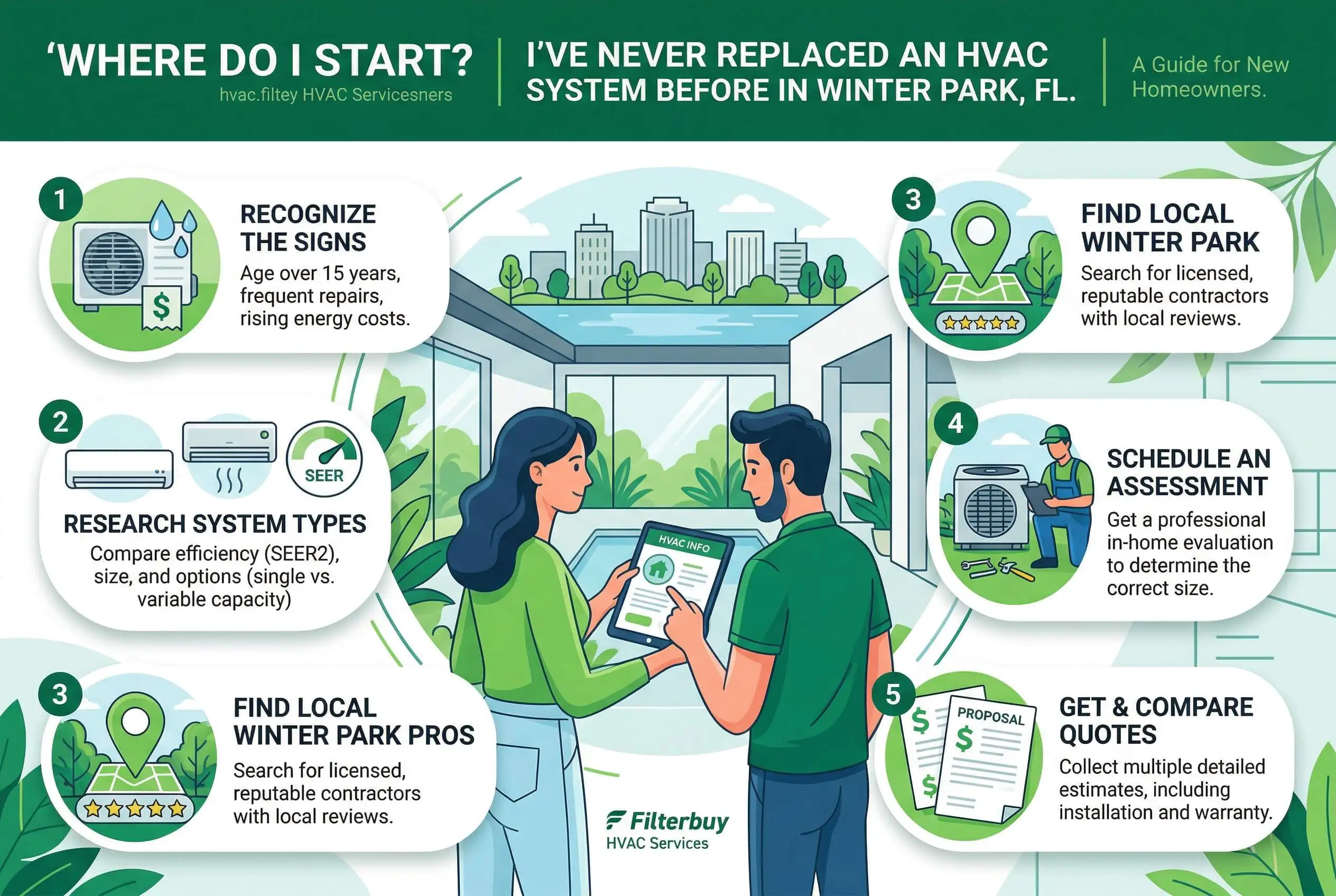
Where Do I Start With My First HVAC Replacement in Winter Park FL?
Check whether your system is 10 to 15 years old or showing signs of declining performance. Both are strong indicators that replacement is the right call.
Call a licensed local contractor for a free in-home evaluation and ask specifically for a Manual J load calculation before any equipment is discussed.
Confirm the SEER2 efficiency rating your contractor recommends for Central Florida’s climate before selecting a system.
Expect the installation to take 4 to 8 hours once the equipment is selected and the permit is pulled.
Get written, itemized estimates from at least two licensed contractors, and verify each contractor’s license at the Florida DBPR before committing.
Ready to Start Your First HVAC Replacement in Winter Park FL?
Schedule your free in-home evaluation with Filterbuy HVAC Solutions — we’ll walk you through every step of the replacement process, from load calculation to final inspection, with no pressure and no surprises.
In I’ve Never Replaced an HVAC System Before — Where Do I Start in Winter Park FL?, a practical place to begin is understanding that a replacement is not just about picking a new unit—it is also about knowing what your finished system will require for airflow, filtration, and routine upkeep once the installation is complete. That is why examples like 20x24x4 MERV 8 air filter, 10x10x1 MERV 8 air filter, and 24x36x1 MERV 8 air filter fit naturally into the topic, because they show how filter size and MERV rating can vary significantly depending on the system a homeowner installs, making it even more important to work with a Winter Park HVAC replacement company that explains compatibility, maintenance needs, and long-term indoor air quality from the start.